Case 03 / AI-assisted editorial workflow
Functional MVPEditorial Cockpit
A structured editorial workflow where AI proposes plans and drafts, and a person reviews the decisions before they are applied.
In brief
- The problem
- Caption drafting was streamlined, but planning and responsibilities still needed coordination.
- My contribution
- Designed the workflow, relational data model and three AI agent roles with human review.
- Result & status
- Functional personal MVP with a public demo; not adopted for agency production.
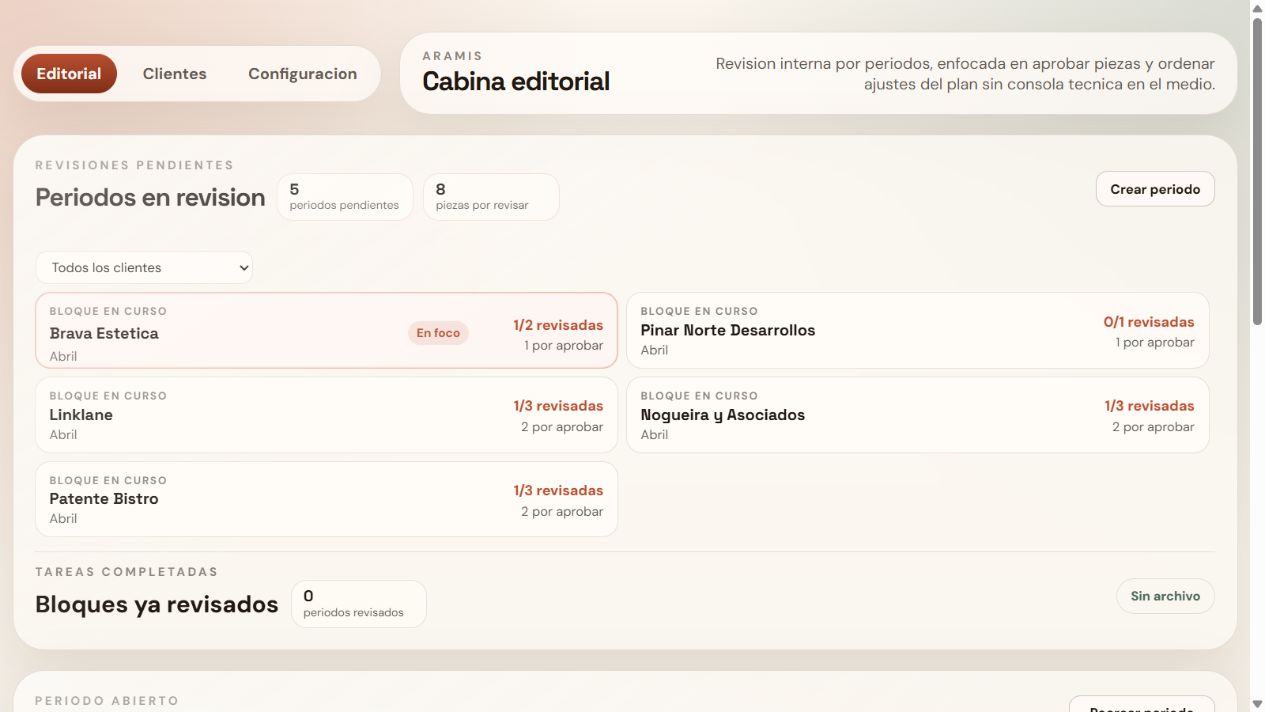
The workflow
We already used custom GPTs to draft captions. Cabina explores how to connect that writing step to client context, an editorial period and individual pieces, while keeping a person in control.
- 01 · Client context
- 02 · AI proposal
- 03 · Human review
- 04 · Apply the plan
The Planner proposes actions such as creating, updating or rescheduling a piece, with a reason for each. A person can inspect and edit the proposal before applying it. Drafts and captions are reviewed at the piece level.
The important interaction is the review: a proposed change stays a proposal until a person approves it.
The decisions I owned
I started with the workflow and an initial relational data model, then refined it with AI. Separating the commercial plan from the editorial period kept the agreed deliverables distinct from a particular batch of content.
I defined three focused roles: a Planner for the plan, a Writer for drafts and captions, and a Story Adapter for story content. A deterministic Orchestrator routes their tasks; human review was a requirement from the beginning.
I sketched interfaces in Excalidraw and guided AI-assisted development in small chunks, testing and debugging each part before moving on.
What you can try
The public demo lets you explore editorial periods, pieces and client configuration, using simulated AI responses. It needs no API key. The linked walkthrough gives a guided tour; the interface is in Spanish.
The project made the review boundary concrete and gave me practice turning a process and data model into a working interface. It remains a personal MVP: the agency continues to use its existing GPT workflow for production.
Implementation, design notes and next steps
The application uses Next.js and TypeScript, Prisma and PostgreSQL. Backend rules validate proposed operations before saving changes. Stub and OpenAI providers share the same output contracts; the public demo uses stubs and makes no live AI calls.
The repository preserves the relational-model notes and agent-role definitions. Authentication, multi-tenancy and background jobs are future work. Revisiting the project would start with the current team workflow and an adoption plan.
Have a similar challenge or a role in mind?
Let's talk